
A quiet home at the end of a private road can offer welcome distance from through traffic. However, the route connecting that home to the public street may come with arrangements that are easy to overlook during a viewing. Road repairs, gate access, deliveries, and waste collection may operate differently from the services you used at your previous address.
Moving to a private road means checking both your ability to reach the property and the practical arrangements that keep it accessible. A road suitable for your car may not accommodate a large moving truck, while a service available elsewhere in the neighborhood may stop at the public-road junction.
Before arranging your arrival, establish who controls the road, what vehicles can use it, and how everyday services reach the home.
Establish Who Owns and Maintains the Road
Start by identifying the road owner and the person or organization responsible for maintenance. These may be different parties.
A homeowners association, road association, individual owner, or group of neighboring owners may manage the route. Responsibility can also change along its length, with one section publicly maintained and another privately maintained.
Ask for the relevant documents rather than relying only on a description in a property listing. Depending on the property, these might include a recorded access easement, road-maintenance agreement, association documents, or lease provisions.
Find out whom residents contact about potholes, fallen trees, drainage problems, and damaged gates. Keep a current telephone number as well as an email address, since an urgent obstruction may require a quicker response.
Separate Access Rights From Maintenance Arrangements
Permission to use a road and responsibility for maintaining it are separate questions.
For a purchase, ask your title professional or real estate lawyer to explain the documented access rights and any restrictions affecting the intended use of the property. For a rental, ask the landlord to clarify what access is included and which responsibilities fall to the tenant.
Questions worth resolving include:
- Does the documented route connect the property to a public road?
- Are there restrictions relevant to delivery or service vehicles?
- Who may authorize work on the road?
- How are maintenance costs allocated?
- Are there known disagreements affecting access or repairs?
A visible, frequently used road does not by itself explain the legal arrangements behind it. Resolve unclear documents before depending on assumptions about future access.
Build Road Costs Into Your Household Budget
Ask how routine and major maintenance are funded. A regular contribution may cover grading or minor repairs without covering resurfacing, bridge work, or a major drainage failure.
Request recent maintenance information and details of any approved or proposed work. Find out whether contributions are fixed, based on an agreed formula, or collected when repairs arise.
For tenants, establish which charges the lease assigns to you and which remain the landlord’s responsibility.
Also check who arranges emergency work and how residents are notified. Knowing that a contractor maintains the road is less useful if nobody can explain how that contractor is called out or paid.
Have the Mover Assess the Entire Approach
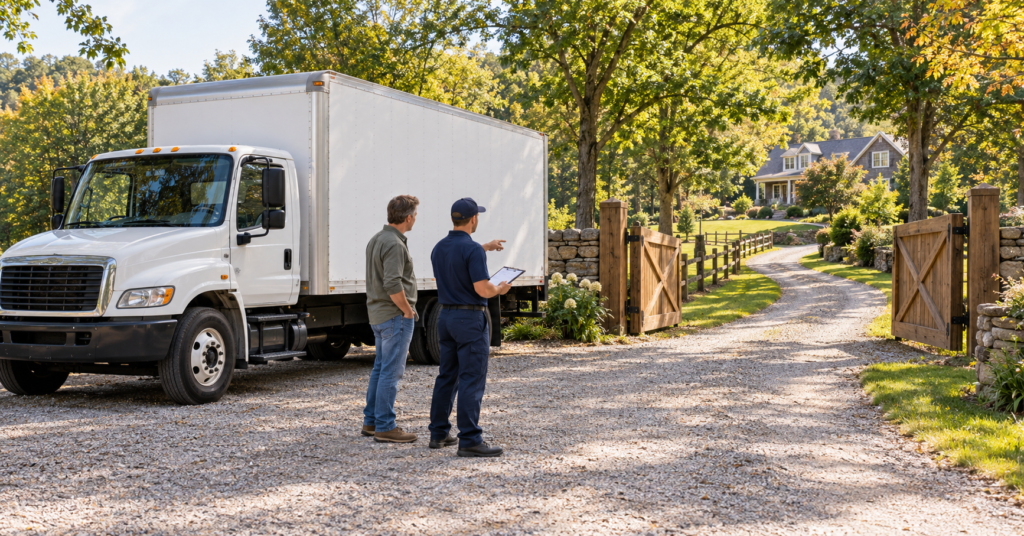
Send the moving company information about the route from the public street to the unloading point. A photograph of the house entrance alone may miss the most difficult section.
Document narrow stretches, tight bends, steep changes in slope, low branches, overhead lines, soft shoulders, and limited passing space. Include gate openings and any posted vehicle restrictions.
Ask the mover what measurements or additional photographs it needs. Where access is uncertain, request an assessment before delivery.
Do not use a successful car journey as evidence that the moving vehicle will fit. Truck height, length, turning requirements, and loaded weight can create different limitations.
Verify Bridges, Culverts, and Turning Space
A small bridge or drainage crossing deserves particular attention. Do not estimate its load capacity from its appearance or assume that an unposted crossing has no limitations.
Ask the road’s responsible party for available information and give it to the mover. If capacity remains uncertain, obtain appropriate professional guidance before allowing a heavy vehicle onto it.
The vehicle also needs a workable way to leave. Identify a suitable turnaround and confirm that the mover can use it.
A neighbor’s driveway should not become the assumed turning area without permission. Similarly, a grassy shoulder or open-looking patch may conceal drainage infrastructure or become unstable under load.
If the main truck cannot safely reach the property, ask about an agreed transfer point and smaller shuttle vehicle, including the additional handling and charges.
Arrange Gate Access Before Delivery Day
For a gated road, establish how residents, visitors, and commercial drivers enter.
Check whether the gate uses a code, remote, telephone directory, staffed entrance, or another system. Confirm that your access will be active by the time you arrive.
Then ask about commercial-vehicle procedures. The moving crew may need advance authorization, specific entry hours, or a different gate.
Avoid sharing a permanent household code more widely than necessary. Ask whether a temporary visitor code or supervised entry is available.
Also learn what happens during a power failure or gate malfunction. Get the approved procedure from the responsible party rather than improvising a way to hold the gate open.
Confirm Mail and Parcel Delivery Separately
Do not assume that an established street address means every delivery service comes to the door.
Ask the local postal office where mail is delivered, whether the property uses a shared mailbox location, and how to obtain any required mailbox key.
Postal delivery can depend on safe access. USPS guidance explains that road conditions obstructing mail delivery must be addressed by the responsible maintenance parties and can affect service if left unresolved.
Parcel carriers may have different arrangements. Confirm where packages are left when a gate is closed or a vehicle cannot reach the house.
For bulky purchases, discuss access before ordering. A retailer’s normal delivery area does not establish that its vehicle can travel the final private-road section.
Check Waste Collection and Other Vehicle-Based Services
Contact the waste provider with the exact address. Ask where containers must be placed and whether collection takes place at the home, a shared point, or the public-road entrance.
If bins must be moved a considerable distance, plan how you will manage that regularly. Check collection-day timing, storage arrangements, and whether anything must be kept clear around the pickup point.
Apply the same address-specific approach to other services you expect to use, such as heating-fuel deliveries, septic servicing, or large-appliance installation.
Explain the road conditions when booking. A company serving the surrounding area may still need to assess access for its particular vehicle.
Understand Seasonal Access Before Your First Bad-Weather Event
Visit or ask about the road under conditions beyond a dry afternoon.
Depending on the location, heavy rain, snow, ice, flooding, wildfire conditions, or seasonal ground softness may affect access. Ask residents and the maintenance contact about recurring trouble spots and documented closures.
Find out who handles snow clearance, storm debris, and drainage problems, and whether that service includes the full route to your property.
Keep an alternative arrival plan for moving day if conditions make the road unsafe. Do not direct a driver through standing water or around a closure because the property is nearby.
Check Emergency Addressing and Communications
Confirm that the property’s official address is clearly displayed and that emergency responders have accurate location information.
For a gated road, ask the local fire or emergency-services authority about any applicable access arrangements. Use its guidance rather than assuming that a resident gate code resolves emergency entry.
Test mobile reception at the house and along the approach. If coverage is unreliable, arrange a suitable way to make calls and contact the road manager.
Save directions that describe the correct entrance. Navigation apps may suggest an unsuitable approach or a neighboring gate, so check the route yourself before sharing it with movers and visitors.
Keep a Practical Access Record
Create one accessible record containing the road-maintenance contact, gate procedure, verified directions, delivery locations, and arrangements for reporting an obstruction.
Share the relevant parts with everyone in the household. Give the mover only the information needed for its visit, including the approved unloading location and a reachable arrival contact.
These checks make the road part of your relocation plan rather than an issue discovered after the truck turns off the public street. They also help you understand the recurring responsibilities of living at the new address.
Note: Private-road access rights, maintenance duties, vehicle limits, and service arrangements vary by property. Review the relevant documents with an appropriate professional and confirm the route with your mover and service providers before arrival.