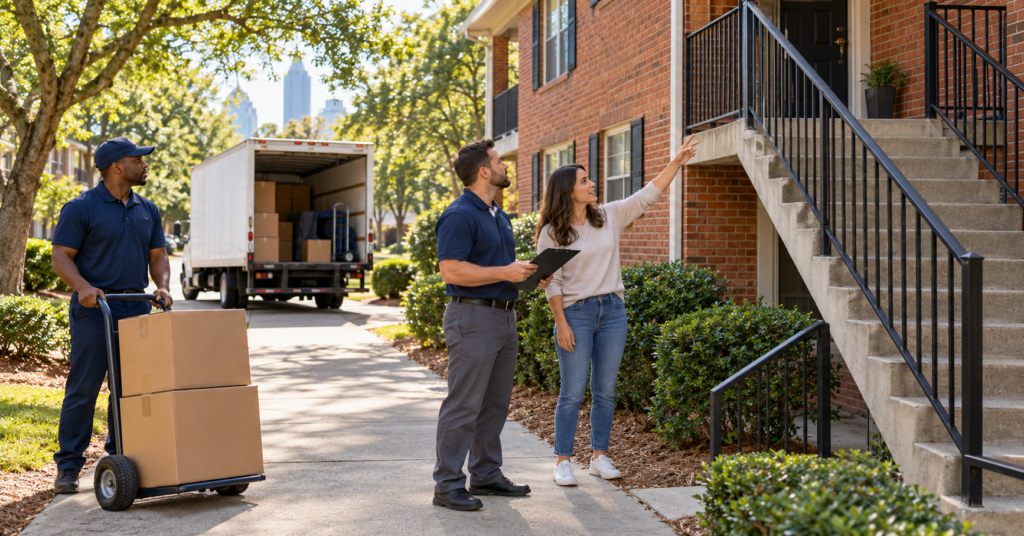
“Third-floor apartment, no elevator” gives a moving company a starting point, but it does not describe the full job. The route might include exterior entrance steps, two narrow staircases, a sharp turn outside the apartment, and a long walk to the nearest available loading point.
Atlanta walk-up apartment moves are easier to assess when you describe the complete route rather than only the floor number. Accurate access details help the mover evaluate staffing, equipment, timing, and any charges associated with the property.
Before requesting an estimate, collect information about the stairs, turning spaces, entrances, and truck location at both addresses. A short access summary supported by photographs can make those details much easier to understand.
Count Stair Runs Instead of Relying on Floor Numbers
Floor descriptions can be misleading. A ground-floor apartment may sit above a raised entrance, while a building on a slope may have different access levels at the front and rear.
Walk the route the movers will actually use. Record each continuous run of steps between landings, along with the number of individual steps in that run.
For example, your description might read:
- Six exterior steps from the sidewalk to the entrance.
- Eleven interior steps to a landing.
- A turn followed by another ten steps.
- Four steps inside the apartment entrance.
Ask the mover how it defines a flight for estimating purposes. Companies may use different descriptions, so providing the actual layout avoids depending on a shared interpretation.
Include steps at the delivery property as well. Loading from a walk-up and unloading into another walk-up are separate parts of the work.
Measure the Narrowest Usable Stair Width
Measure the clear space available along the stair route, including any narrowing caused by handrails or other fixed features.
A wall-to-wall measurement can overstate the usable width if a railing projects into the staircase. Note where the narrowest point occurs and photograph it with the measurement visible when practical.
Check overhead clearance too, particularly beneath sloping ceilings, beams, or the underside of another staircase. Tall furniture may need to change angle while being carried.
Do not remove a handrail or another safety feature to create room without appropriate authorization and assessment. Give the mover the existing conditions so it can evaluate a suitable approach.
Record the Space Available at Landings
A wide staircase can still lead to a difficult turn.
Measure each landing’s usable length and width, and explain whether the route turns straight ahead, through a right angle, or back in the opposite direction. Include doors opening onto the landing and any fixed obstructions.
Photograph the approach and the exit, rather than taking only a close-up of the floor. The mover needs to understand how a long object would enter, turn, and leave.
For large furniture, our furniture access measurement checklist explains other dimensions worth collecting around doorways and hallways.
Measurements support an access review; they do not guarantee that a particular piece will fit. Ask the mover to assess uncertain items before the appointment.
Identify Furniture That Changes the Handling Plan
Prepare a short list of items that may be difficult on stairs. Examples include a long sofa, solid-wood dresser, large mattress, glass cabinet, or heavy exercise equipment.
Provide dimensions and model information where available. Describe detachable legs, removable shelves, or other components, but do not assume that taking the item apart will be included.
Ask who will perform any agreed disassembly and whether it must happen before the crew arrives. Specialist preparation may require a separate arrangement.
Also mention unusual weight. An item’s size alone may not explain its handling needs, and a small piece can still require additional planning.
Establish a Realistic Truck Loading Location
Look beyond the space directly outside the building.
Ask the property manager where moving vehicles may stop and whether a loading area must be reserved. Check posted street restrictions and any current construction that affects the approach.
Describe the likely truck position, including whether it is on the same side of the street as the entrance. Mention gates, covered entrances, tight driveways, and any vehicle-size limitations.
Do not treat an empty curb space during your visit as a reservation. Likewise, permission from building management does not automatically authorize parking in a restricted public location.
If access is uncertain, give the mover a proposed alternative and ask how it would affect the work. Our guide to moving trucks that cannot park near the home covers the planning issues created by a more distant loading point.
Measure the Carry Along the Actual Route
Carrying distance should follow the path the crew must use, rather than a straight line between the apartment and truck.
Record the horizontal sections separately: the apartment hallway, the route through the building, and the outdoor path to the proposed loading point. Describe stairs alongside those distances so the layout stays clear.
Note surfaces and obstacles that affect handling, such as gravel, uneven paving, a steep path, or doors that must be opened repeatedly.
Ask the mover which endpoints it uses when calculating carrying distance and whether any distance is included in its pricing. Do not assume your own measurement method matches the company’s charging method.
A description such as “approximately 70 feet outdoors, plus a 30-foot interior hallway and the stairs listed above” is more useful than “parking is quite close.”
Review the Access Details With Magic Movers ATL
Once your stair notes, measurements, and photographs are ready, contact Magic Movers ATL to discuss its apartment moving services and the access conditions at your properties.
Ask how to submit the information for review and whether a video walkthrough or on-site assessment would help with uncertain areas. Highlight the tightest landing, the heaviest items, and the proposed truck position.
Use that discussion to clarify the proposed crew, equipment, and any preparation expected from you. Request an estimate that reflects the access information supplied, and ask which changes could affect the price.
The aim is to give the team enough detail to evaluate the work before moving day, rather than expecting the driver to resolve an unfamiliar staircase after arrival.
Make Your Photos Show a Continuous Journey
Organize photographs in the order the crew will encounter each part of the route.
Start at the proposed loading point, continue toward the building entrance, and then show the stairs, landings, hallway, and apartment door. Add short captions explaining measurements or turns.
A slow video can help connect the images, provided it is safe to record. Stop walking before focusing on measurements, and avoid filming while distracted on stairs.
Keep other residents and private information out of the images where possible. Send gate codes or access credentials separately through an appropriate channel.
Include photographs of the destination route in a clearly named second group so the two properties are not confused.
Ask How Access Affects the Estimate
Stairs and carrying distance may affect a move through additional labor time, specific charges, or a combination described in the agreement.
Ask the estimator to explain:
- How stair access is reflected in the price.
- Whether a carrying-distance allowance applies.
- Whether special equipment adds a charge.
- How waiting for building access is handled.
- What happens if the agreed truck location is unavailable.
For hourly work, establish the crew size, minimum booking period, and when billable time begins and ends. Do not assume that an absence of a separate stair charge means the staircase has no effect on the total.
Keep the access description with the estimate so you have a record of the conditions discussed.
Reconfirm Conditions Before the Crew Arrives
Check the route again shortly before moving day. Construction barriers, parked vehicles, broken lights, or items left in shared areas can change the access originally reviewed.
Notify the mover about meaningful changes while there is time to adjust the plan. Confirm keys, entry arrangements, moving hours, and the person who will meet the crew.
Inside the apartment, finish packing and keep the carrying route clear. Arrange for children and pets to remain away from active handling areas.
Accurate preparation gives an Atlanta walk-up move a clearer starting point: the crew knows the route, you understand the agreed service, and difficult access has been discussed before loading begins.
Note: Stair descriptions, carrying-distance calculations, equipment needs, and access-related charges vary by mover and property. Provide details for both addresses, confirm the estimate in writing, and report changes to parking or building access before moving day.