A portable moving container can give you time to load belongings gradually instead of completing everything during one truck appointment. However, that flexibility depends on having an approved place to leave it. A container that fits your furniture may still conflict with community rules, obstruct a sidewalk, or require more delivery space than your driveway provides.
Planning Phoenix moving containers means coordinating three separate issues: permission to use the location, the delivery company’s access requirements, and a pickup schedule that fits the permitted placement period. Confirming only one of these can leave you with a booking that cannot proceed as expected.
Before reserving a container, work through the following checks for your specific property.
Start With the Community’s Current Moving Rules
If your home belongs to a homeowners association, request its current rules for temporary moving or storage containers. Relevant restrictions may appear in the community’s governing documents, parking rules, architectural guidelines, or a separate moving policy.
Ask how the association classifies the container. A rule about trailers or recreational vehicles may not clearly explain whether a portable storage unit is covered.
Useful questions include:
- Are temporary moving containers allowed?
- Is advance written approval required?
- Which locations may be used?
- Is there a maximum placement period?
- Are particular dimensions or screening arrangements required?
- Who can authorize an exception?
Do not rely on a neighbor’s previous move as proof of permission. Their placement may have involved different circumstances or a specific approval.
Arizona’s planned-community statute addresses monetary penalties for violations of association documents, subject to notice and an opportunity to be heard. You can review Arizona Revised Statutes § 33-1803, but the practical starting point is identifying the actual rule that applies to your property.
Submit a Placement Request With Specific Details
A request that simply says “moving container” may leave the association without enough information to make a decision.
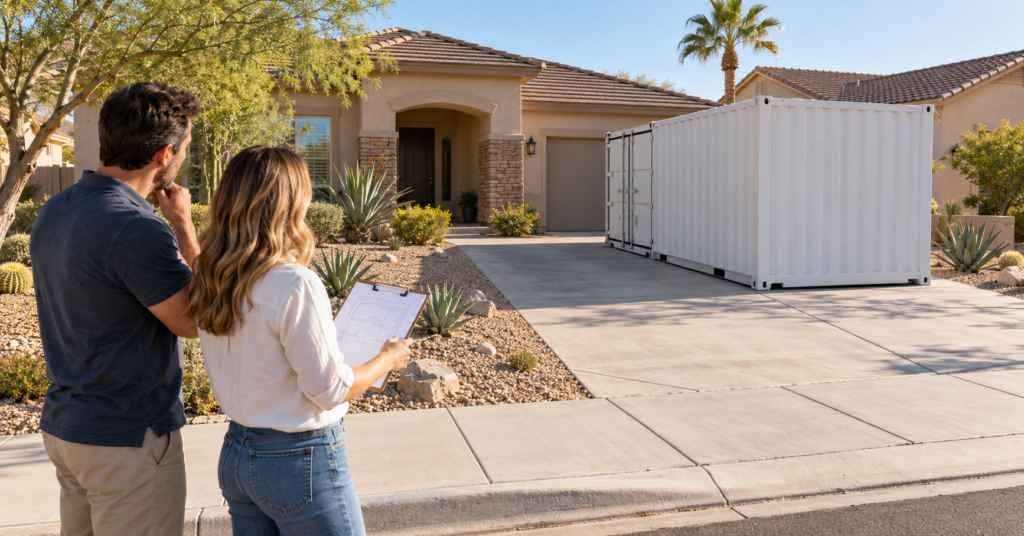
Provide the proposed container dimensions, delivery date, pickup date, and placement location. Include a driveway photograph or simple property sketch showing where the container would sit.
Explain whether the container is for loading before departure or unloading after arrival. If the booking includes a delivery window rather than a guaranteed date, disclose that uncertainty.
Ask whether the approval covers the full requested period and whether it includes any conditions. For example, permission might depend on keeping the sidewalk clear or using one particular section of the driveway.
Keep the written response with your moving records. If you rent the property, involve the owner or property manager early, since the association may require the owner to submit the request.
Distinguish Private Property From Streets and Sidewalks
A driveway location and a street location can involve different permissions. HOA approval does not establish that you may occupy public right-of-way.
Likewise, a street inside an HOA neighborhood is not necessarily privately owned. Confirm its status rather than assuming the association controls every nearby paved area.
The City of Phoenix’s special-permits information describes how certain encroachments in public right-of-way are reviewed. That page is a starting point for inquiries, not blanket authorization to place a moving container on a street.
If your proposed location extends into a sidewalk, street, or other possible right-of-way, ask the city which requirements apply to the exact placement. Provide the address, dimensions, and intended dates.
For a property outside Phoenix city limits, check with the municipality responsible for that address. A Phoenix mailing address alone should not determine which local rules you follow.
Measure the Delivery Area, Not Just the Container Footprint
A container may fit within the driveway while its delivery vehicle cannot safely position it there.
Ask the provider for the access requirements associated with the container and delivery equipment you are booking. These should cover maneuvering space, overhead clearance, surface conditions, and any restrictions on slopes.
Photograph or measure potential obstacles such as:
- Garage overhangs and roof edges.
- Tree branches and overhead lines.
- Narrow gates.
- Curved or steep driveways.
- Parked vehicles.
- Low walls and landscaping.
- Tight turns near the property.
Send these details before delivery. Do not assume the driver can move the container sideways, lift it over an obstruction, or use a different unloading method.
If the approved location is difficult to reach, request a site assessment or written confirmation of feasibility before committing to the booking.
Check Door Clearance and Everyday Access
The container’s doors need usable space after placement. A unit positioned tightly against a garage, wall, or vehicle may be impossible to load efficiently.
Confirm which direction the doors will face and how much space is needed to open them. Then consider the route between the house and the container.
Keep pedestrian access, required exits, and access to utility equipment available. Avoid a placement that forces you to carry furniture through landscaping or across an unsuitable surface.
Also plan where household vehicles will park. If the container takes the usual driveway spaces, moving cars onto the street may create a separate community parking issue.
A placement sketch should therefore show both the container and the access you need around it.
Match the Allowed Period to the Provider’s Schedule
The association’s placement limit and the provider’s rental period may operate differently.
Clarify whether the HOA counts calendar days, overnight stays, or another period. Ask whether the delivery and collection days are included.
Then establish how pickup works with the provider. A collection request may require advance notice, and availability may vary by location or date.
For example, permission through Friday creates a problem if the earliest available collection is Monday. Resolve that mismatch before the container arrives.
Avoid treating the final permitted day as the only possible pickup date. Where practical, allow time for a missed appointment or scheduling change.
Prepare for a Delay Before You Need an Extension
Closing delays, incomplete loading, or changes in the moving schedule can extend the time a container remains at the property.
Ask the HOA how an extension would be requested and who can approve it. An initial approval should not be interpreted as automatic permission to stay longer.
Also ask the provider about charges for changing pickup dates, keeping the container longer, or moving it into off-site storage.
If the container must leave before you finish loading, identify an alternative in advance. You might need a shorter loading session with hired labor or another moving method that does not require overnight placement.
The right backup depends on the specific restriction. A smaller container, for instance, does not resolve a rule prohibiting all temporary containers.
Coordinate Entry Into Gated Communities
For a gated property, confirm how the delivery and collection vehicles will enter.
A resident’s gate code may not be sufficient for a large commercial vehicle. Ask about visitor lanes, staffed entry hours, vehicle restrictions, and any required advance notification.
Give the provider accurate entry instructions and identify a person who can be reached during the appointment.
Check collection access separately. The container may arrive while you are present but need pickup after you have moved out. Arrange continued authorization rather than assuming the driver can reuse the original entry process.
Photograph the Location Before and After Placement
Take photographs of the driveway or other approved surface before delivery. Include existing cracks, marks, nearby landscaping, and the intended loading area.
Ask the provider whether protective supports are used and whether you must supply anything. Do not place improvised materials beneath the container without confirming they are suitable for the equipment.
Once delivered, photograph its position and check that it matches the approved arrangement. If it obstructs access or sits outside the agreed area, contact the provider promptly.
Inspect the surface again after collection and retain your records if a concern needs follow-up.
Keep the Placement Plan With Your Booking
Before delivery, gather the approval, placement sketch, provider instructions, access details, and collection confirmation in one accessible place.
The person meeting the driver should know the permitted location and any conditions. If you cannot attend, share those details with whoever will supervise placement.
A workable Phoenix moving-container plan gives every party the same information: where the unit belongs, how it can be reached, and when it must leave. That preparation helps keep the loading schedule from becoming a placement dispute.
Moving Note: HOA permission, municipal requirements, and the container provider’s access rules are separate checks. Confirm the exact location and approved dates in writing, and arrange pickup early enough to meet the placement deadline.