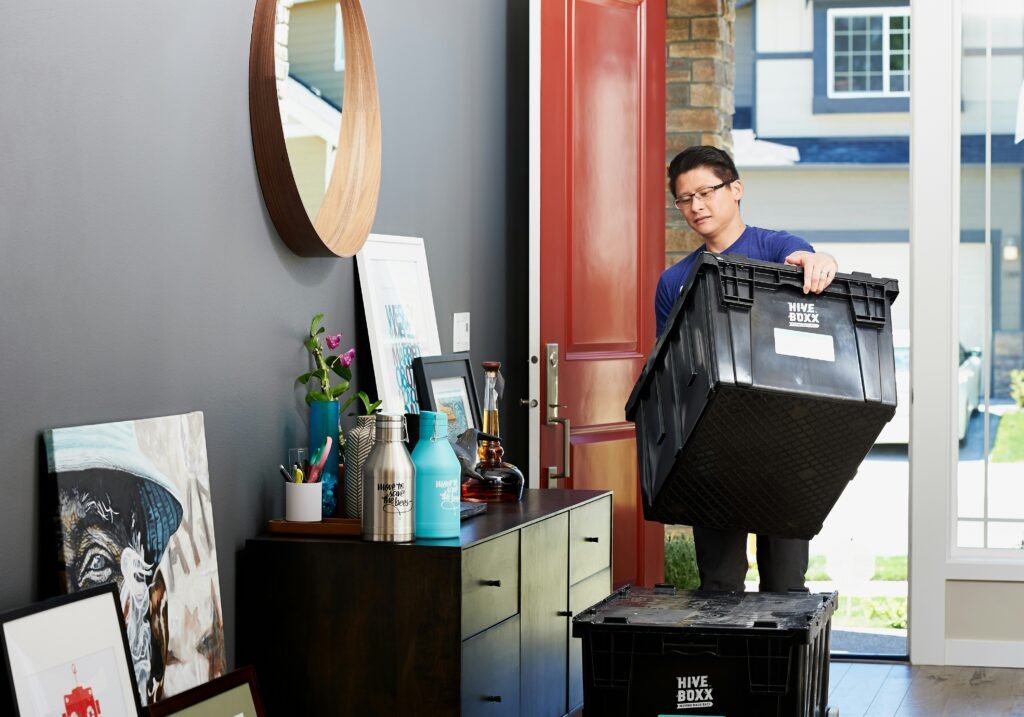

A steep driveway may prevent a portable moving container from being delivered safely. The container requires a firm and reasonably level location, while the delivery vehicle needs enough space to approach, position and retrieve it.
A slight incline may be acceptable in some situations, but there is no universal slope limit for every container or delivery system. The decision depends on the container’s dimensions, driveway surface, direction of the slope, surrounding clearance and delivery equipment.
Do not wait until delivery day to disclose an inclined driveway. Send photographs and measurements in advance and request confirmation that the proposed placement area is suitable.
Why Does the Driveway’s Slope Matter?
A portable moving container can remain on the property for days or weeks while being loaded. Its weight changes as furniture and boxes are added.
An unsuitable slope can create several problems:
- The container may not sit level.
- Its door may become difficult to open or close.
- Belongings may shift toward one end.
- Loading carts may roll unexpectedly.
- Workers may lose their footing.
- Rainwater may collect around the container.
- The delivery equipment may not be able to operate safely.
- Pickup may become difficult after the container is loaded.
- The driveway surface may crack or sink under concentrated weight.
A delivery that appears possible while the container is empty may become unsafe when the container is fully loaded. Both placement and removal must be considered.
How Steep Is Too Steep?
There is no single slope percentage that applies to every portable moving container. Different container sizes and delivery systems have different operating limits.
The following conditions deserve additional review:
- A vehicle rolls noticeably when placed in neutral.
- A car door will not remain open when parked on the slope.
- Walking downhill feels unstable.
- The driveway has a sharp transition from the street.
- The slope changes significantly within the proposed placement area.
- The driveway tilts sideways as well as downhill.
- The container would lean toward the home, sidewalk or street.
- The delivery vehicle would need to operate across the slope.
- The loaded container could not be retrieved from the same position.
Informal tests may help you recognize a significant incline, but they cannot determine whether delivery is safe. The delivery operator must evaluate the actual site and equipment requirements.
Measure the Proposed Placement Area
Before booking, measure the section of the driveway where the container would sit.
Record:
- Available length
- Available width
- Overhead clearance
- Distance from the street
- Distance from the garage
- Approximate change in elevation
- Narrowest point in the approach
- Space available for the delivery vehicle
- Location of drains, utility covers and soft ground
Measure the entire approach rather than only the container’s final position. Delivery equipment may require considerably more room than the container itself.
TCM’s furniture and property access checklist can help you document other access restrictions before moving day.
Check the Direction of the Slope
A driveway can slope in several ways:
- Upward from the street toward the home
- Downward from the street toward the home
- Sideways across the driveway
- In multiple directions
- Through a sharp change in grade
A sideways tilt can be particularly problematic because the container’s weight may not be distributed evenly. It may also make stacking belongings safely more difficult.
The direction the container door faces matters as well. An opening facing sharply downhill could allow carts, boxes or loose objects to roll toward the door. However, you should not select the orientation without discussing it with the delivery operator.
Evaluate the Driveway Surface
Slope is only one part of the decision. The driveway must also support the container and delivery equipment.
Concrete
Concrete may provide a stable surface, but existing cracks, thin sections and unsupported edges can be vulnerable. Do not assume that every residential concrete driveway was designed for a loaded container.
Asphalt
Asphalt can soften during hot weather. Container supports may leave impressions or contribute to surface damage, particularly when the load remains in one position for an extended period.
Gravel
Hard-packed gravel may be suitable in some situations, but loose material can shift on a slope. The container may settle unevenly as it is loaded.
Pavers or bricks
Individual pavers can move, crack or sink under concentrated loads. Decorative driveways may need additional protection or an alternative placement location.
Dirt or grass
Soft or wet ground may not provide reliable support. Rain can cause settling, rutting or loss of traction for delivery equipment.
Photograph cracks, soft areas and previous damage before delivery. Ask whether protective boards or other approved materials are permitted. Do not install improvised supports without authorization.
Consider the Container’s Loaded Weight
The weight placed on the driveway includes more than the empty container. Household belongings can add several thousand pounds.
Heavy contents may include:
- Books
- Tools
- Appliances
- Solid-wood furniture
- Exercise equipment
- Filing cabinets
- Workshop materials
- Dense boxes of household goods
Distribute weight as evenly as possible during loading. Avoid concentrating all heavy belongings at the downhill end or along one side.
Follow the container’s specified weight limit. Exceeding it can create transportation, structural and pickup problems even when the driveway itself appears strong.
Check Overhead and Side Clearance
A level driveway can still be unsuitable when there is not enough clearance for the delivery equipment.
Look for:
- Tree branches
- Utility lines
- Roof overhangs
- Carports
- Basketball hoops
- Gates
- Fences
- Retaining walls
- Parked vehicles
- Mailboxes
- Street signs
- Landscaping
- Neighboring structures
Clearance may be required above and around the delivery vehicle throughout the placement process. Do not estimate visually when exact measurements can be taken.
Never attempt to move utility lines or cut branches near electrical equipment yourself.
Watch for Sharp Grade Transitions
Some driveways are not continuously steep but have an abrupt change in angle near the street, sidewalk or garage.
A sharp transition can cause:
- Delivery equipment to scrape the pavement
- The truck to lose clearance
- The container to sit across two different angles
- Supports to carry weight unevenly
- The container door to become misaligned
- Difficulty retrieving the loaded container
Photograph the driveway from the side so the change in grade is visible. A front-facing photograph may make the slope appear flatter than it actually is.
How to Document the Driveway Before Booking
Provide enough information for the proposed delivery to be reviewed before the driver arrives.
Send:
- A photograph looking up the driveway from the street
- A photograph looking down toward the street
- A side view showing the slope
- A photograph of the proposed container location
- Images of overhead wires and branches
- Measurements of the available area
- Details about the driveway surface
- Information about gates or access restrictions
- The approximate location of underground structures
- Any parking or permit limitations
A short video walking from the street to the placement area may reveal turns and grade changes that photographs miss.
Request written confirmation whenever possible. The driver may still make the final safety decision after seeing the property in person.
What Happens If Delivery Is Refused?
A driver may refuse placement when the site does not meet safety or equipment requirements.
Possible consequences include:
- The container being returned
- A failed-delivery charge
- Rescheduling costs
- Delayed moving plans
- The need to load at another location
- Additional transportation expenses
- Losing a building or parking reservation
Ask about the failed-delivery policy before booking. Find out whether you can submit photographs for advance approval and whether an alternative location can be placed on file.
Alternative Placement Options
If the steep driveway is unsuitable, another arrangement may still allow you to use a moving container.
A flatter section of the property
A level side parking area or another driveway section may work if it has sufficient access and ground strength.
A legal street location
Some municipalities allow portable containers to occupy a street or parking space with advance permission. Local permits, time limits, visibility requirements and traffic rules may apply.
Contact the local transportation, parking or public-works department rather than assuming street placement is allowed.
A nearby private property
A neighbor or relative may have a suitable paved area. Obtain permission and confirm whether local rules or insurance conditions affect the arrangement.
Loading at a storage or transfer location
In some cases, belongings can be transported in a smaller vehicle and loaded into the container at a level off-site location.
This arrangement adds handling but may be safer than attempting delivery on an unsuitable slope.
Using a moving truck instead
A conventional moving truck may be more practical when a container cannot remain at the property. The truck still requires safe parking and loading access.
Read TCM’s guide on what to do when a moving truck cannot park near your home when evaluating this alternative.
Do You Need a Permit?
Permit requirements depend on where the container will be placed.
A container located entirely on private property may not require the same authorization as one placed on:
- A public street
- A sidewalk
- A parking lane
- A shared driveway
- An alley
- Property controlled by an association
Local rules may regulate placement duration, visibility, setbacks and container size. Apartment communities and homeowners associations may impose additional restrictions.
Confirm the rules before scheduling delivery. A permit does not guarantee that the physical location is safe for the container.
Protecting the Driveway
Even an approved placement can leave marks or cause damage.
Before delivery:
- Photograph the entire driveway.
- Document cracks and stains.
- Remove vehicles and obstacles.
- Identify irrigation lines and drains.
- Ask whether protective materials are allowed.
- Avoid placing supports near unsupported edges.
- Confirm responsibility for surface damage.
- Keep the proposed area dry and accessible.
Do not place random lumber, blocks or wedges beneath the container. Unapproved supports can shift, split or create unstable loading.
Loading a Container on an Incline
If placement on a mild slope is approved, loading requires additional care.
- Wear shoes with good traction.
- Keep the approach clear.
- Do not leave carts unattended.
- Load heavy belongings low.
- Distribute weight across the container.
- Secure belongings in sections.
- Avoid tall, unstable stacks.
- Keep the doorway clear.
- Do not work during ice or heavy rain.
- Stop if the container appears to shift or settle.
Use straps or other approved restraints to prevent belongings from moving during transportation.
TCM’s guide to household items that must stay upright can help you plan the load.
Questions to Ask Before Scheduling Delivery
Ask the following questions:
- Are sloped driveways accepted?
- Is there a maximum permitted slope?
- How should the slope be measured?
- Can photographs be reviewed in advance?
- What surface types are acceptable?
- How much clearance does the delivery equipment need?
- Who makes the final placement decision?
- What happens if the driver refuses delivery?
- Will a failed-delivery fee apply?
- Can an alternative location be approved?
- Are protective boards permitted?
- Must someone be present?
- What access is required for pickup?
- Does the loaded container have different retrieval requirements?
Keep the answers with your booking documents.
Frequently Asked Questions
Can a moving container be placed on a sloped driveway?
A container may be accepted on a mild slope if the surface, clearance and delivery conditions are suitable. Approval depends on the equipment and the actual property.
Is a steep driveway more difficult during pickup?
Yes. A container that was delivered while empty will be much heavier after loading. The delivery equipment must be able to retrieve it safely from the same location.
Can blocks be used to level the container?
Do not use improvised blocks or supports. Ask which leveling or surface-protection methods are approved for the container and delivery system.
Can a container be placed on gravel?
Firm, compacted gravel may be accepted in some situations, but loose or sloped gravel can shift. Advance review is necessary.
Who is responsible if the driveway is damaged?
Responsibility depends on the agreement, property condition and circumstances. Photograph the driveway beforehand and review the damage terms before delivery.
Can the container be placed on the street instead?
Street placement may be possible when local rules allow it and the required permit is obtained. The space must also meet delivery and traffic-safety requirements.
Moving Note: Container dimensions, weight limits, slope tolerances and delivery requirements vary. Obtain approval for the specific placement location before delivery, and follow local permit and property-access rules.