After a paddle on Lady Bird Lake, the carry bag is a convenient way to get your inflatable paddleboard home. But the way you pack it at the launch is different from the way you want to leave it for a month. Water can hide under the deck cords, grit can collect in the fin track, and a board that fits easily in its bag can still be crushed under heavier moving boxes.
Good Austin paddleboard storage starts with three decisions: where you can dry the board completely, how your model is meant to roll, and whether the spot you plan to use stays within the manufacturer’s storage limits.
Unpack the Board After the Drive Home
If you bagged the board while it was wet, open the bag when you get home and take everything out. A dry board can pick up moisture again if it goes back into a damp carry bag, so open the bag wide and let its lining, seams, and pockets air out too.
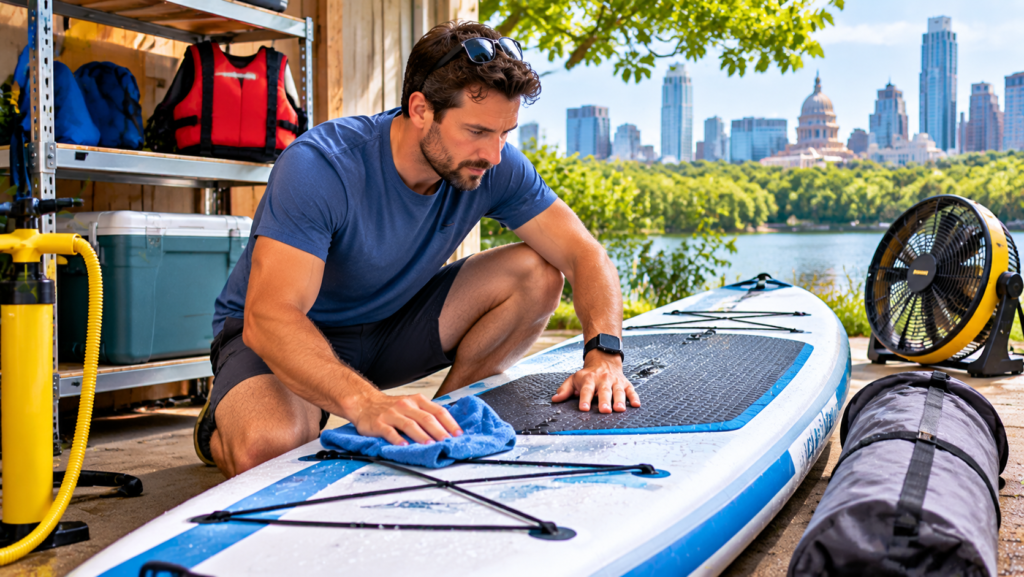
Lay the board on a clean surface in the shade. Remove the detachable fin, then rinse off dirt and grit with fresh water. Pay attention to the fin track and the area under the deck cords, where debris is easy to miss. Follow the board maker’s instructions before using any cleaner. NRS’s inflatable paddleboard care guide also recommends cleaning and drying the board before transport or storage. (nrs.com)
Check the underside, the edges of the deck pad, and the fabric around the carry handle before you pack. A simple test is to press a dry cloth against those spots. If it comes away damp, leave the board out longer. In an apartment, a clean tarp and a fan can make an indoor drying area when you don’t have a shaded patio or garage.
Let the Fin Box Decide How You Roll
Check the manual for the recommended deflation method, rolling direction, and finished shape. The right approach depends partly on where the rigid fin box sits and whether the board has any fixed fins. Take a photo of the factory roll the next time you unpack a new board, or keep the manufacturer’s packing diagram with your gear.
Release the air as directed, then guide the board into broad curves. If the material starts to fold sharply across the fin box, back up and adjust the roll. If the finished bundle is too bulky for the bag, check for trapped air or a piece of gear caught inside before tightening a strap. The zipper should close without having to pull the sides together under force.
For longer storage, check whether your manufacturer allows the board to rest loosely rolled or partially inflated. A carry bag is designed to make the board portable; it doesn’t have to determine how tightly you store it between paddling seasons.
Give the Paddle and Fin Their Own Space
A removable fin has a hard edge that can press into the board when a bag is squeezed between boxes. Put it in a padded pocket or a separate accessory pouch. Keep small pieces, such as a fin screw or locking clip, in a labeled bag so they don’t disappear into the bottom of the main bag.
For a sectional paddle, wipe the joints dry before separating and packing the pieces. Protect the blade and keep the paddle from bearing the weight of other gear. Coil the pump hose in a broad loop so it doesn’t have to bend around the edge of the board bag.
If you’re moving, put the fin, paddle, pump, and leash on the same inventory line as the board or label their cartons as part of the same set. That way, you can tell at a glance whether you have everything for your first outing after the move.
Check the Heat Where the Board Will Actually Sit
Start with the manufacturer’s recommended storage conditions for your exact model. Then look at the spot itself. A shaded interior closet, a shelf beside a sun-facing garage door, and a parked car can expose the same board to very different conditions.
If the garage is your only option, place a thermometer with a maximum-temperature reading at the height and location where the board will sit. Check it after a hot spell, not just on the day you pack. If the space exceeds the manufacturer’s guidance, choose an indoor closet or ask a storage facility what temperature range it maintains. If the manual gives no numeric range, ask the manufacturer rather than guessing at a universal cutoff.
For a move that involves an overnight stop or several days between pickup and delivery, ask where the load will wait. If you have the option to keep the paddleboard with you, bring it indoors during the stop instead of leaving it in a parked vehicle.
Protect the Board From the Rest of the Load
Choose a shelf that supports the whole rolled board and keeps it off a floor where a leak or spill could soak the bag. Keep paint, fuel, and lawn tools elsewhere, and leave enough room to lift the bag out without dragging it past sharp edges.
On a moving truck, the board bag can look like a soft space filler. Tell the crew it contains an inflatable paddleboard with a rigid fin box. Place it where furniture legs, toolboxes, and tie-down straps won’t press into it. If the paddle travels in a separate carton, label that carton so it doesn’t end up beneath a stack of books.
Inspect It Before the First Paddle Back
Take the board out at home before you head for the water. Check the seams, valve, deck pad, and fin mount for visible damage, then inflate it according to the manufacturer’s instructions. Make sure the fin seats properly and the paddle joints lock. If the board loses pressure or a seam looks damaged, have it checked before using it on the lake.
For the rest of your move, see our guide to what should and should not go into a storage unit.
Note: This guide covers inflatable paddleboards. Follow your model’s manual for storage temperature, rolling direction, and inflation pressure. Rigid paddleboards need a different packing and support setup.