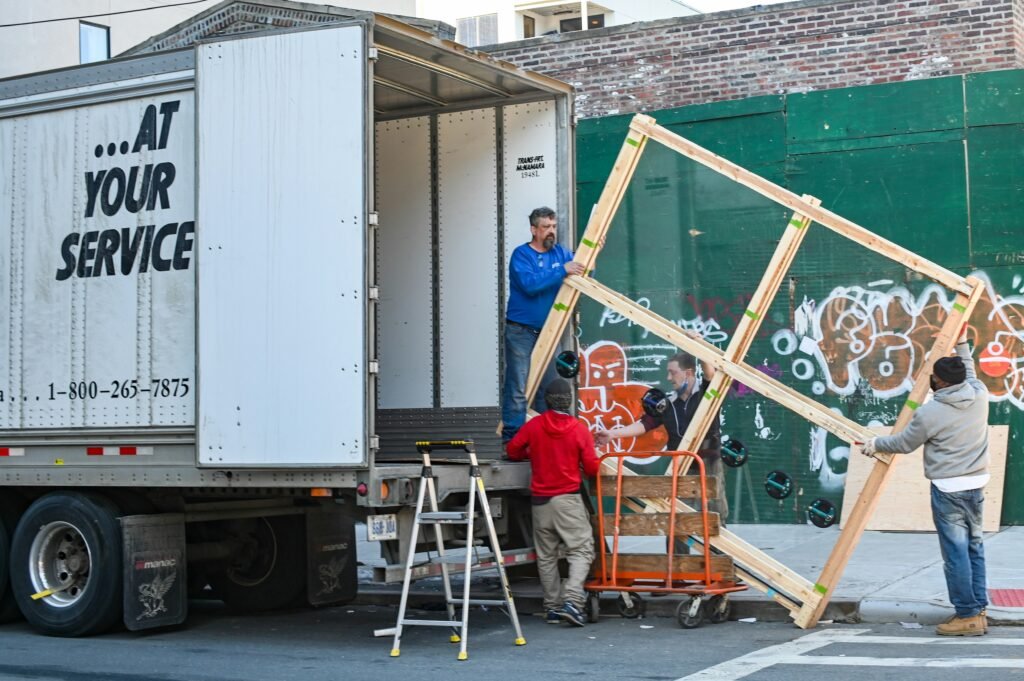

One moving company recommends two workers, while another proposes three. The smaller crew has a lower hourly rate, but the larger crew estimates an earlier finish. Deciding which offer represents better value requires more than comparing the advertised prices.
Austin moving crew size should be assessed against the same inventory, access conditions, and service requirements. An additional worker can help when several tasks can happen together, but may offer less benefit when everyone depends on one narrow staircase or a shared elevator.
Before choosing a crew, ask each company to explain how its recommendation fits your particular move.
Give Every Estimator the Same Job
Start with a consistent description of the belongings and work involved.
Provide the furniture list, approximate carton count, and details of heavy or delicate items. Explain whether packing, furniture disassembly, and reassembly are required.
Then describe both properties. Include stairs, elevator reservations, loading entrances, and the likely distance between the truck and the door.
If one company prices a fully packed apartment while another allows time for packing, their crew recommendations are not directly comparable.
Send updates to every company still under consideration when your inventory changes. Removing a large furniture set or adding belongings from storage can affect the staffing assessment.
Confirm What the Crew Rate Includes
Ask whether the quoted hourly figure covers the entire crew or each worker individually.
Also establish whether the driver is included in the stated headcount and participates in loading and unloading. “Three-person crew” should describe the people available to perform the work, rather than leave you guessing about their roles.
Check whether the truck is included in the same rate. A labor-only offer cannot be compared directly with a service that includes transportation.
Request a clear description of the proposed arrangement: number of workers, vehicle, included equipment, and booked services.
Our guide to moving estimates and what they should include can help you organize those details before comparing totals.
Compare Expected Totals Using Illustrative Calculations
A higher hourly rate can produce a lower labor total if the work takes sufficiently less time. However, that result depends on a realistic estimate of the hours.
Consider these hypothetical examples, which are calculations rather than Austin market prices:
| Crew option | Illustrative crew rate | Illustrative billable time | Labor subtotal |
|---|---|---|---|
| Two movers | $150 per hour | 6 hours | $900 |
| Three movers | $210 per hour | 4 hours | $840 |
| Three movers | $210 per hour | 5 hours | $1,050 |
The third worker saves money in the four-hour example but costs more in the five-hour example. Neither outcome establishes what your move will require.
At those example rates, the three-person crew would need to finish in less than approximately four hours and seventeen minutes to beat the two-person crew’s six-hour labor subtotal.
Add the actual minimums, travel charges, and other applicable costs before comparing offers. Do not treat an estimated duration as a guaranteed finish.
Ask Which Tasks an Extra Worker Would Perform
Have the estimator explain where the additional person would help.
For example, one worker might prepare furniture while two others carry ready items. Another arrangement might keep someone organizing the truck while the remaining workers bring belongings from the home.
That division only works when the property and inventory support it. If every large item requires the same workers together, fewer tasks may proceed independently.
Ask for an explanation tied to your home rather than a general claim that three people are always faster.
A useful question is: “Which parts of this move would happen simultaneously with the larger crew?”
Identify Access Bottlenecks
Some delays depend more on the route than the number of workers.
A small elevator may carry only one cart at a time. A tight landing can limit how many people safely handle a piece of furniture. A controlled service entrance may require repeated assistance from building staff.
In these situations, another worker may still help with staging or preparation, but cannot eliminate the restriction itself.
Send photographs of difficult areas and confirm the usable elevator dimensions. Ask the company to explain how the proposed team would work around those conditions.
Do not encourage workers to crowd stairs, overload an elevator, or rush handling to justify the larger crew.
Check Truck Capacity Separately
More workers do not create more vehicle space.
Confirm that the proposed truck can accommodate the disclosed shipment and ask what happens if another trip becomes necessary. Additional driving and repeated loading setup can alter the comparison between crew options.
If a quote includes multiple vehicles, establish whether that is necessary for capacity, access, or scheduling. Ask how staffing and charges are allocated between them.
An estimate built around one trip is not equivalent to an offer that anticipates two.
Provide accurate information about garage contents, patio furniture, and stored belongings so the vehicle recommendation reflects the whole shipment.
Account for Minimum Hours and Billing Increments
A larger crew may finish the physical work sooner without reducing the bill below the booking minimum.
Ask each company about its minimum charge and how additional time is rounded. Also clarify whether travel counts toward that minimum or is billed separately.
For instance, a crew finishing in two and a half hours may still generate a three-hour minimum charge under the agreed terms. Compare the actual payable amount rather than multiplying only the time spent carrying furniture.
Our guide to moving company minimum hours explains the questions worth asking for smaller shipments.
Check when billing begins and ends, including any time associated with departure from or return to the company’s base.
Explain Austin Access Windows and Route Concerns
Tell the estimator about any firm apartment moving slot or loading reservation.
A larger team may be proposed to complete handling within that window. Ask whether the company considers the schedule achievable and what assumptions support its assessment.
Travel conditions matter too, but adding a worker does not shorten the road journey. If event closures could affect either property, review our guide to Austin moving dates and event closure checks before fixing the appointment.
Keep the access deadline distinct from the estimated job duration. A four-hour estimate does not mean the company has committed to a particular arrival time.
Read the Written Proposal Before Loading
For a move performed entirely within Texas, review the applicable state guidance rather than relying only on an advertised hourly rate.
The Texas Department of Motor Vehicles explains that movers must provide a written proposal before loading, describing the services and stating the maximum amount payable for the listed work. Its Texas moving consumer guide also explains binding and not-to-exceed proposals.
Check that the paperwork reflects the crew and services you agreed to. Ask how inventory additions or requested extra work would be documented.
For interstate transportation, different requirements apply. Confirm which rules govern the shipment instead of assuming the same paperwork applies to every route.
Agree on Staffing Changes in Advance
Ask what happens if the company arrives with a different number of workers.
A smaller team could affect the estimated duration and your building reservation. A larger team could affect the rate if the company expects to charge for the change.
Establish who can approve staffing adjustments and how any revised terms will be recorded. Do not assume you must accept an unexplained rate change at the door.
Before work begins, review the arriving crew, vehicle, inventory, and access plan with the crew leader. Resolve discrepancies while the agreed scope is still clear.
Choose the proposal that explains the complete job convincingly. Crew size is one part of that decision, alongside preparation, suitable equipment, realistic timing, and transparent charges.
Moving Note: Crew rates, minimum hours, travel charges, and staffing needs vary by company and shipment. The figures above are hypothetical examples, not Austin price estimates. Compare written proposals covering the same work and confirm how staffing or service changes affect the agreed charges.