
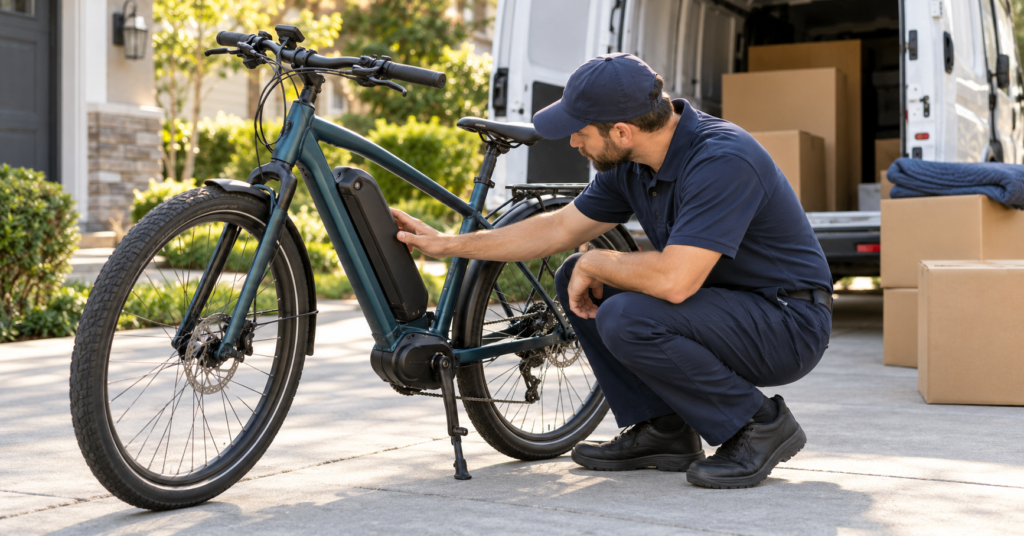
Moving with an e-bike requires an agreed transport plan for both the bicycle and its battery. Before pickup, the mover needs to know which battery you have, whether it will remain installed and whether any spare packs are included. A quote that simply lists “bicycle” leaves those details unresolved.
Lithium batteries are regulated during commercial transportation in the United States. Their condition and shipping arrangement affect the requirements, while the carrier determines which shipments it will accept. The Pipeline and Hazardous Materials Safety Administration’s lithium battery guidance explains this framework.
This guide focuses on preparing for a U.S. household move, including what to arrange if you will fly while your belongings travel separately.
Identify the Battery Before Requesting Approval
Photograph the label on the battery actually fitted to your e-bike. An online description of the bicycle may show its original specification, which could differ from a replacement or upgraded pack.
Send the mover a short equipment record:
| Detail | Information to provide |
|---|---|
| E-bike identification | Manufacturer, model and approximate complete weight |
| Battery identification | Battery manufacturer and model number |
| Rated capacity | Watt-hours shown on the label or confirmed by the manufacturer |
| Battery arrangement | Removable or integrated, plus any spare packs |
| Condition and history | Known damage, repairs, modifications or recall notices |
Watt-hours describe the battery’s rated energy capacity. When the documentation gives only nominal voltage and amp-hours, multiplying those figures provides the corresponding watt-hour value. For example, a hypothetical 48-volt, 14-amp-hour battery is rated at 672 watt-hours. Use the manufacturer’s stated rating when available, and ask for clarification if the label is unreadable.
Identify each spare separately. Approval for the battery installed in the bike does not establish approval for another pack stored in a pannier.
Confirm Whether the Battery Will Travel Installed or Removed
Removing an e-bike battery does not automatically simplify shipping. A battery secured in the bicycle, a removed battery packed with it and a battery shipped on its own can fall under different requirements.
Under 49 CFR 173.220, installed lithium batteries must be secured and protected against damage and short circuits. The regulation also distinguishes a removed battery packed with the vehicle from one left installed.
Ask the carrier to confirm the exact configuration it accepts and who will prepare it. Get that arrangement recorded in the booking details before removing parts or sealing cartons.
For an integrated battery, consult the manufacturer’s instructions about whether removal is a user task. Do not open the battery casing or dismantle the electrical system to satisfy an informal suggestion from a booking agent. If the proposed arrangement conflicts with the manufacturer’s guidance, resolve it before collection.
Check for Damage, Recalls and Unexplained Changes
Inspect the accessible casing, mounting points and connectors without taking the pack apart. Report cracks, swelling, leakage, damaged contacts, unusual heat or a history of significant impact or water exposure. A battery that still powers the bike may nevertheless need professional assessment.
Search the CPSC recall and product safety warning database using the bike and battery details. Follow the instructions for the affected model if a notice applies.
Do not place a suspect battery in the household shipment while waiting for advice. PHMSA identifies damaged, defective and recalled lithium batteries as presenting greater transport risks. Contact the manufacturer or an appropriate hazardous-materials specialist about the next step. If a battery is smoking or actively overheating, keep people away and call emergency services.
If disposal is required, use the specified collection route. The EPA’s used lithium-ion battery guidance explains why these batteries belong outside household trash and ordinary recycling. Contact the receiving facility before bringing it a damaged e-bike pack.
Obtain Packing and Charge Instructions for the Actual Journey
Request preparation instructions that match the agreed transport method. These should address the accepted charge level, terminal protection, packaging, prevention of accidental activation and any required shipment markings or documents.
Do not apply a charge percentage found in an air-freight article to every household move. Requirements depend on the shipment, and the manufacturer may also specify conditions for transport or storage. PHMSA’s Lithium Battery Guide for Shippers separates guidance by battery type and shipping arrangement.
For a separately shipped pack, have the responsible carrier or qualified packer specify the packaging. Bubble wrap, a recycled carton or a fire-resistant pouch alone does not establish that a package meets the applicable requirements. Keep exposed contacts away from metal objects and follow the approved protection method.
If professional packing is required, confirm its price and appointment before moving day.
Prepare the Bicycle and Keep Its Accessories Accounted For
Once the battery arrangement is settled, agree how the bicycle itself will be handled. Tell the crew about a cargo frame, unusually wide handlebars or other features that affect lifting and available space.
Photograph the frame, display and visible components before wrapping. Remove loose bags, bottles and detachable accessories as appropriate, and label their destination box. Keep battery keys accessible until preparation and loading are complete.
Follow the manufacturer’s procedure for any wheel, pedal or handlebar removal. If you are unfamiliar with the work, arrange competent assistance and clarify who will reassemble the bike. Ask the packer to protect controls and cables from pressure during loading.
Pack the correct charger with an identifying label so it can be matched to the battery after delivery.
Arrange an Alternative Before the Moving Truck Arrives
If the mover declines the battery, ask whether it can still carry the bicycle without it. A separate transport provider experienced with lithium batteries may be an option, subject to the pack’s condition and acceptance requirements. Obtain a complete quote covering preparation, collection and delivery.
For someone moving with an e-bike and flying to the destination, ordinary passenger baggage may not solve the problem. The FAA’s guidance for battery-powered recreational vehicles prohibits these devices in checked or carry-on baggage when the battery exceeds 160 watt-hours. Airlines can impose additional restrictions, and removing a larger battery does not make it eligible as an ordinary spare.
The limit concerns rated capacity, not the charge remaining. Discharging the hypothetical 672-watt-hour pack described earlier would not turn it into a battery rated below 160 watt-hours.
Resolve this before booking transport around an assumption that the battery can accompany you on the flight.
Include Any Storage Stop in the Plan
A move involving temporary storage needs a separate acceptance check. Ask whether the storage operator permits the bicycle in its agreed configuration and whether separately packed batteries are allowed.
Tell the operator how long storage is expected to last. Check the manufacturer’s temperature and storage-charge guidance against the proposed conditions, particularly if delivery could be delayed.
If the battery and bicycle take different routes, record both tracking references and expected arrival dates. Keep any storage or delivery changes linked to the correct shipment.
Record the Handoff and Inspect Before Charging
At pickup, make sure the inventory reflects what the mover actually takes: the bicycle, an installed battery if accepted, and any separately accepted accessories or packages. Retain photographs, preparation instructions and collection receipts with your moving documents.
On arrival, examine the battery housing, mounting points, connectors and bike before reconnecting or charging anything. Report new damage and obtain advice about anything that appears unsafe. Have disturbed mechanical components checked before the first ride.
The CPSC’s micromobility safety guidance recommends using the charger supplied or recommended by the manufacturer and remaining present during charging. Follow the manufacturer’s temperature and charging instructions after the journey.
Note: This article provides general information for U.S. household moves. Battery transport requirements vary by shipping configuration, condition, route and transport method. Confirm current requirements with the carrier and relevant authorities; international moves require additional checks.