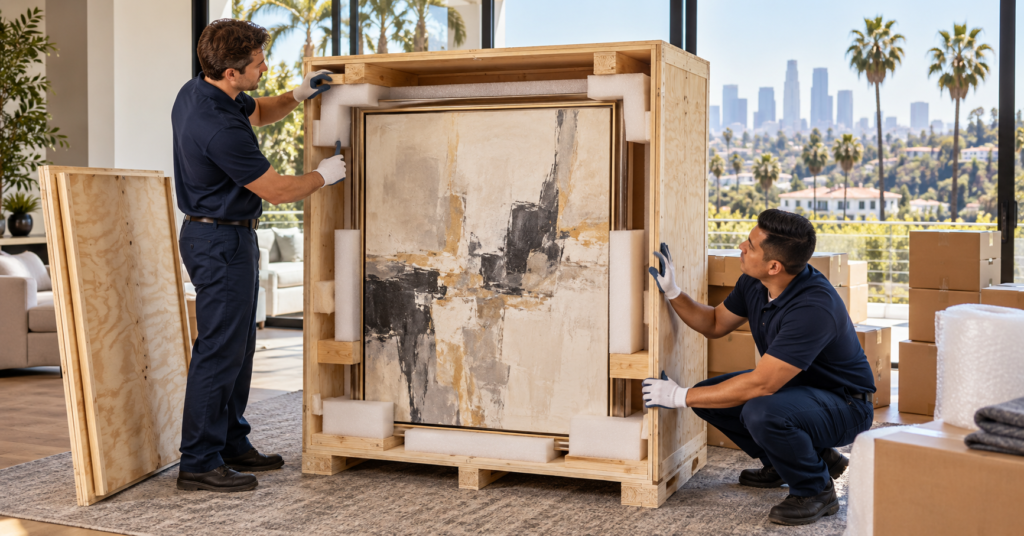
Los Angeles custom crating costs can be difficult to compare because providers may include different work in their estimates. One price might cover an empty wooden crate, while another includes preparing the item, securing it inside and opening the enclosure at the destination.
For anyone moving a large mirror, sculpture, glass tabletop or delicate furniture, the important starting point is a description of the complete service. Knowing how the object will be protected and handled helps you decide whether the proposed cost fits the job.
What Affects Custom Crating Costs
The item’s dimensions and weight help determine the enclosure’s size and structure. Its shape, condition and vulnerable features influence the protection needed inside.
A rectangular object with a durable surface presents different packing challenges from a sculpture with projecting parts. Both might fit inside similarly sized crates, but their supports and preparation requirements can differ substantially.
Ask the estimator to explain the design and identify any work beyond fabrication. This might include taking measurements, preparing protective supports, separating removable components or arranging specialist handling.
The moving arrangements matter as well. Tell the provider whether the item will travel directly to the new home, pass through storage or be handled by another receiving team. These details help establish the packaging and opening requirements before the price is agreed.
Compare the Complete Service Price
Request enough detail to understand which parts of the job are included. A single combined price can be useful, provided the written description clearly defines the work.
| Service component | What to establish |
|---|---|
| Assessment and design | Whether measurement or consultation carries a separate charge |
| Crate fabrication | The enclosure, base, fasteners and agreed construction work |
| Interior packing | Protective materials, supports and labor to secure the item |
| Transport | Whether moving the loaded crate is included in this price |
| Destination work | Opening the crate, placing the item and removing packaging |
Consider a hypothetical comparison. Provider A charges $300 for construction, $120 for packing and $100 for uncrating and packaging removal, bringing those services to $520. Provider B charges $480 for the same scope. Assuming transportation is excluded from both, Provider B is $40 less expensive.
These example figures illustrate how to compare estimates; they are not published Los Angeles rates or a quotation from the featured company.
You can place the crating allowance within your wider budget using the Los Angeles moving cost guide, which covers broader household moving expenses.
Ask Why a Crate Is Appropriate
A recommendation should explain the specific risks to your item. Ask which parts are susceptible to pressure, movement or surface damage and how the proposed packing addresses them.
The Canadian Conservation Institute advises matching packaging to the object’s characteristics and the conditions of its journey. Some controlled transport situations can accommodate lighter packaging, while more demanding handling may require a stronger enclosure.
If the item has cracks, loose decoration or an unstable surface, disclose that before accepting the proposal. An already damaged artwork may require conservation advice before packing.
A useful question is: “Which features of this item make your proposed protection appropriate?” The answer helps you assess the provider’s understanding of the object.
Check the Finished Crate Against Both Properties
Ask for the expected outside dimensions once the item is packed. Include the base, handles and any other projecting components when discussing clearance.
For a Los Angeles apartment move, check elevator openings, the space inside the elevator and turns along the delivery route. At a house, review gates, exterior steps and the entrance the crew expects to use.
An object that passes through a doorway unpacked may require a different route once enclosed. If the crate must be assembled or opened in a particular location, agree on that sequence before fabrication.
Give the estimator access information for the pickup and delivery addresses. This allows the packaging plan to account for the whole move.
How Piece of Cake Can Help With Custom Crating in Los Angeles
Piece of Cake Moving & Storage lists custom crating among the services described in its Los Angeles content. Its crating information explains a process that includes assessing the item and discussing a design suited to transportation and unpacking.
For someone moving a fragile possession alongside other household belongings, the company can be a relevant option to discuss both parts of the job. Provide photographs, dimensions, condition details and the planned destination so the team can assess the requested service.
Ask how the crate preparation would fit into the moving schedule and whether the proposed arrangement includes the destination work you need. If the object requires a separate installer or specialist, clarify that responsibility during planning.
This keeps the discussion focused on the actual item and the practical arrangements needed to move it. Request a written description of the agreed work before booking.
Schedule Preparation Before the Moving Crew Needs It
Confirm whether the provider builds the crate off-site, assembles it at the property or requires an earlier visit. Knowing the sequence helps you arrange access and avoid leaving preparation unfinished when loading is due to begin.
If a separate contractor handles crating, identify who books that appointment and coordinates it with the mover. Ask how a delayed preparation visit would affect the moving schedule or any hourly charges.
Building rules can affect where assembly takes place. Check permission to use the proposed work area and whether the appointment falls within permitted service hours.
Also ask when fabrication begins and what happens if you change the measurements, postpone the move or cancel. Get the applicable alteration and cancellation terms before authorizing construction.
Agree on Uncrating, Placement and Installation
Describe the condition in which you expect the item to be left at delivery. That might mean a closed crate in a designated room, an unpacked object placed on the floor or a piece positioned on its existing stand.
Installation needs its own discussion. Unpacking a chandelier does not establish that electrical work is included. Opening a crate containing a heavy mirror does not automatically include attaching it to the wall.
Identify who will carry out each task and make sure the receiving team has any necessary opening instructions. Arrange the workspace so the object can be removed without obstructing the rest of the delivery.
Finally, decide who takes away the empty enclosure and packing materials. In an apartment, leaving a large crate behind can use valuable space needed for unpacking. If removal is outside the mover’s scope, arrange it separately.
Consider Whether the Crate Is Worth Keeping
Keeping a suitable crate may reduce preparation work for a later move. Some reusable designs can be dismantled for compact storage, as described in Canadian Conservation Institute guidance.
Ask whether you will own the enclosure and whether its design supports repeated assembly. Store any removable supports, panels and instructions together so they remain identifiable.
Compare the potential future saving with the cost and practicality of storing it. If you already have a crate, let the provider inspect its dimensions, condition and internal protection before assuming it can be reused.
Put the Agreement and Item Details in Writing
For household moves entirely within California, the Bureau of Household Goods and Services states that a visual inspection is required with the estimate. Its guidance also explains that adding items after inspection requires a signed change order for an in-state move.
Check that the fragile item is clearly identified in the paperwork and that the crating charges are accounted for in your overall budget. When more than one business is involved, establish which company is responsible for each service and how each will be paid.
Keep photographs showing the item’s condition before packing. Review damage protection separately and ask what value information or documentation the mover requires for the selected arrangement.
Before accepting the estimate, you should be able to follow the plan from preparation through delivery and identify the charges attached to the services you have chosen.
Note: This article provides general planning information. Custom crating prices and requirements vary by item, property access and service scope. The numerical example is illustrative only. Confirm current availability, charges, damage protection and all included services directly with the mover before booking.