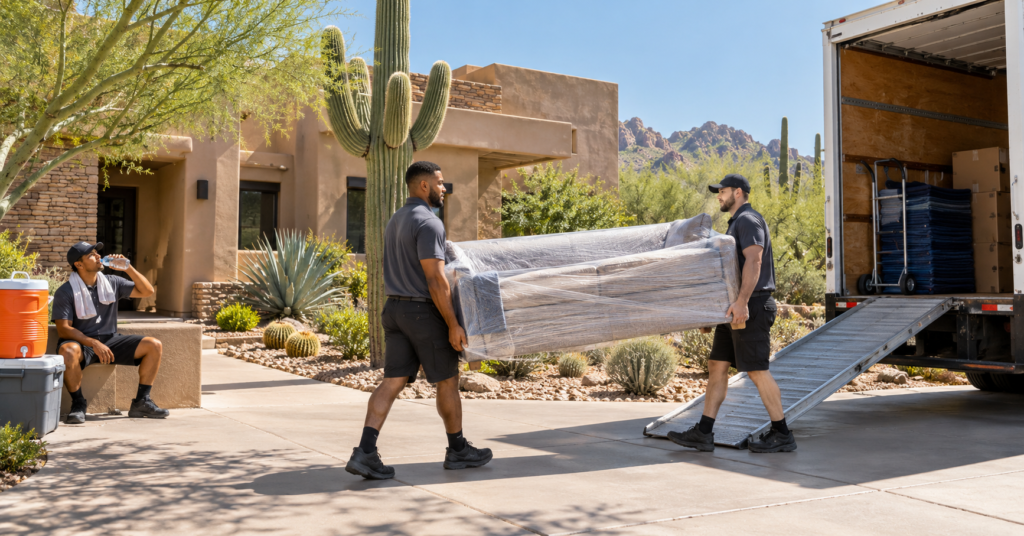
Moving expenses are normally influenced by shipment size, crew size, travel time and property access. During a Scottsdale summer, temperature can introduce another variable: the amount of productive work that can be completed safely within each hour.
Professional crews may need more frequent water and cooling breaks during extreme heat. Heavy lifting can also become slower as the day progresses, particularly when movers are working inside an uncooled garage, storage unit or moving truck.
A Scottsdale summer moving cost may therefore depend partly on the appointment time, the readiness of both properties and the company’s heat-safety procedures. Customers should discuss these conditions before accepting an hourly estimate.
How Summer Heat Can Affect an Hourly Move
Most local moves are billed according to the crew’s hourly rate and the number of billable hours. If high temperatures slow the work or require additional breaks, the move may take longer than the estimate prepared under normal conditions.
Heat does not necessarily create a separate surcharge. Its financial effect may instead appear through:
- Additional labor time
- Cooling and hydration breaks
- Slower handling of heavy furniture
- More time spent rotating crew members
- Delayed access to an air-conditioned property
- A second day of service for a large move
Customers should ask how the company records heat-related breaks. Some movers may treat them as part of normal billable time, while others may use a different policy.
Why the Starting Time Matters
An early appointment can place the most demanding work in a cooler part of the day. It also reduces the chance that the crew will begin late because an earlier job exceeded its estimated duration.
Morning availability is often limited during Scottsdale’s hottest months. Customers who need a particular date may have to reserve the first appointment well in advance.
An afternoon slot is not automatically unsuitable, but the estimate should account for the conditions. A small apartment move with elevators and covered loading may be manageable later in the day. A large home with outdoor stairs, a distant truck and a full garage may require a different plan.
Ask whether the scheduled time represents a confirmed arrival or a window following another move.
Heat Breaks and the Final Invoice
Cooling breaks are a safety measure rather than wasted time. The financial question is whether the customer will be billed for them and how frequently they may occur.
Before hiring movers, ask:
- Are scheduled cooling breaks billable?
- Can the crew rest inside an air-conditioned area?
- Does the company add another mover during extreme heat?
- Can work be paused or rescheduled under dangerous conditions?
- What happens if the move exceeds the estimated hours?
- Is overtime priced differently?
- Will the customer be notified before additional time is authorized?
A written answer is more useful than assuming every company follows the same procedure.
Crew Size Can Change the Calculation
A larger crew usually costs more per hour, but it may complete the work faster and allow movers to rotate demanding tasks. A smaller crew may have a lower rate while requiring more total hours.
Neither option is automatically less expensive. The better choice depends on the shipment, access and temperature.
For example, an additional mover may be useful when the property contains:
- Heavy furniture
- Multiple staircases
- A packed garage
- Outdoor equipment
- Large appliances
- A distant loading area
- Items requiring disassembly
Ask the estimator why a particular crew size is being recommended and whether the recommendation changes for a summer move.
Property Readiness Can Control Labor Time
The most effective way to limit summer moving expenses is to remove avoidable delays. Movers should not arrive to find that boxes are unfinished, furniture is still full or the destination is locked.
Before the crew arrives:
- Finish packing and sealing boxes
- Label rooms and fragile contents
- Empty furniture that must be moved
- Clear the route to the entrance
- Reserve elevators and loading areas
- Obtain gate access instructions
- Confirm that utilities are active
- Cool both properties when possible
- Separate belongings that are not being moved
- Keep children and pets away from the route
A crew waiting outside a gated community or an unavailable apartment may remain on the clock while temperatures continue to rise.
Garages and Storage Areas Need Special Attention
A climate-controlled home may feel comfortable while an attached garage, outdoor storage space or detached building becomes much hotter.
Garages also tend to contain irregular items that require sorting or special preparation. Tools, shelving, exercise equipment, patio furniture and loose household supplies can consume more time than a room of packed boxes.
Prepare garage contents before moving day by:
- Disposing of items the mover cannot transport
- Draining approved outdoor equipment when required
- Securing sharp tools
- Packing loose parts
- Separating chemicals and flammable materials
- Creating a clear path to the door
- Identifying anything that needs disassembly
Do not leave the crew to sort an entire garage during the hottest part of the appointment.
Temperature-Sensitive Belongings
The cargo area of a moving truck is not the same as climate-controlled storage. Heat-sensitive belongings may be damaged even when the transportation distance is short.
Consider transporting the following items separately:
- Medications
- Candles and wax products
- Certain cosmetics
- Houseplants
- Wine and other temperature-sensitive beverages
- Batteries
- Photographs
- Vinyl records
- Electronics
- Important documents
- Perishable food
Ask the mover about prohibited items and temperature-sensitive belongings before packing. Removing unsuitable items at the last minute can delay loading.
Packing Services During Summer
Professional packing can make a move easier, but adding packing on the morning of an hourly move may push loading into the hottest portion of the day.
A separate packing appointment may be more efficient for a large household. It gives the crew time to finish boxes and prepare furniture before transportation begins.
If packing and moving will occur on the same day, ask:
- How many packers will be assigned?
- How long is packing expected to take?
- When will the truck loading begin?
- Are packing materials billed separately?
- Could the work continue into late afternoon?
- What happens if the full move cannot be completed that day?
Partial packing can be another option. The customer handles clothing, books and simple rooms, while the professionals prepare the kitchen, artwork and fragile belongings.
Long Carries and Uncovered Loading Areas
The distance between the entrance and the truck affects every trip made by the crew. A long carry becomes especially important when the route is exposed to direct sunlight.
Potential causes include:
- Restricted community parking
- Narrow residential streets
- Apartment loading rules
- Parked vehicles blocking the nearest space
- Trucks prohibited from using a driveway
- Gated properties with designated loading areas
Provide photographs or measurements of the route during the estimate. A mover who assumes the truck can park beside the entrance may calculate a substantially different completion time.
Covered parking does not always guarantee easy access. Low clearance may prevent the moving truck from entering a garage or structure.
Gated Communities and HOA Scheduling
Some Scottsdale communities regulate truck access, moving hours and the entrances commercial vehicles can use. A guard station may require the driver’s details, proof of insurance or advance approval.
Confirm requirements with the property manager or homeowners association before reserving the movers.
Determine:
- Which gate the truck must use
- Whether the vehicle needs advance authorization
- When commercial access begins
- Whether moving is prohibited on certain days
- Where the truck can park
- Whether a certificate of insurance is required
- Whether streets have truck-size restrictions
- When gates or loading areas close
An early moving appointment will not help if the community does not permit contractor access at that hour.
Estimating a Scottsdale Summer Move
A basic local estimate may be calculated as:
Hourly crew rate × billable time + travel + materials + additional services = estimated cost
Summer conditions primarily affect the billable-time portion. The estimate becomes more reliable when the mover receives a complete inventory and accurate access information.
Provide:
- The number and size of rooms
- An inventory of furniture
- The approximate number of boxes
- Stairs at both properties
- Elevator requirements
- Parking distance
- Gate and HOA restrictions
- Garage and patio contents
- Heavy or specialty items
- Packing services required
- The preferred appointment time
A video or in-person survey may be helpful for a large home, estate property or shipment containing specialty belongings.
Questions to Ask Scottsdale Movers
Customers researching Scottsdale providers may encounter national brands such as Black Tie Moving alongside independent Arizona operators. Regardless of company size, each mover should provide clear written answers about pricing, scheduling and heat procedures.
Ask each company:
- Is the estimate hourly or fixed?
- What is the minimum charge?
- When does billing begin and end?
- Are travel and fuel included?
- How are cooling breaks billed?
- What crew size is recommended?
- Is an early-morning arrival guaranteed?
- Could another job delay the crew?
- Are stairs and long carries included?
- What happens during an excessive-heat warning?
- Can the date or time be changed?
- Which belongings should not enter the truck?
- What conditions could increase the final price?
Use the same inventory and property information when requesting each quote.
Comparing Summer Moving Estimates
| Estimate component | What to verify |
|---|---|
| Labor | Crew size, hourly rate and billing increments |
| Minimum charge | Required number of billable hours |
| Arrival time | Confirmed appointment or estimated window |
| Heat breaks | Whether cooling periods remain billable |
| Travel | Included in the rate or charged separately |
| Access | Gates, stairs, elevators and parking distance |
| Packing | Labor and materials included |
| Specialty items | Separate handling or equipment charges |
| Overtime | Rate after the estimated duration |
| Rescheduling | Weather and excessive-heat policies |
A lower hourly rate does not always produce the lowest total. A prepared crew with an appropriate truck and realistic schedule may finish more efficiently.
Should You Avoid Moving During Summer?
Summer relocation may be unavoidable because of lease dates, property closings, employment changes or school schedules. The objective is not necessarily to postpone the move but to reduce exposure to the hottest and least predictable conditions.
Consider:
- Reserving the first appointment of the day
- Moving on a weekday when availability permits
- Completing packing in advance
- Confirming air conditioning at both properties
- Reducing unnecessary belongings
- Separating heat-sensitive possessions
- Preparing gate and parking access
- Allowing flexibility if dangerous conditions develop
Customers with flexible dates can ask whether another day or time offers better availability or pricing. Any savings should be confirmed in the written estimate rather than assumed.
Frequently Asked Questions
Does summer heat create a separate moving surcharge?
Not necessarily. Some movers may not charge a specific heat fee, but additional labor time, crew requirements or schedule changes can affect the total.
Are cooling breaks included in billable time?
Policies vary. Ask the mover how hydration and cooling breaks are recorded before accepting an hourly estimate.
Is an early-morning move cheaper?
An early start may improve efficiency, but it is not guaranteed to have a lower hourly rate. Morning appointments may also be in greater demand.
Can movers stop working because of extreme heat?
A company may pause, modify or reschedule work when conditions create a safety concern. Ask about its excessive-heat policy and how a delay would affect your charges.
Which belongings should not remain in a hot moving truck?
Medications, plants, candles, food, wine and other temperature-sensitive possessions may need separate transportation. Confirm the mover’s prohibited-items policy.
How can I reduce Scottsdale summer moving cost?
Finish packing, clear all pathways, arrange gate access, reserve loading areas and make both properties available on time. These steps reduce avoidable labor rather than compromising necessary safety breaks.
Note: Moving prices and heat procedures vary by company, crew, property and service level. Review the forecast through the official National Weather Service Phoenix office and confirm labor minimums, cooling-break policies, access charges and schedule-change terms in writing before moving day.